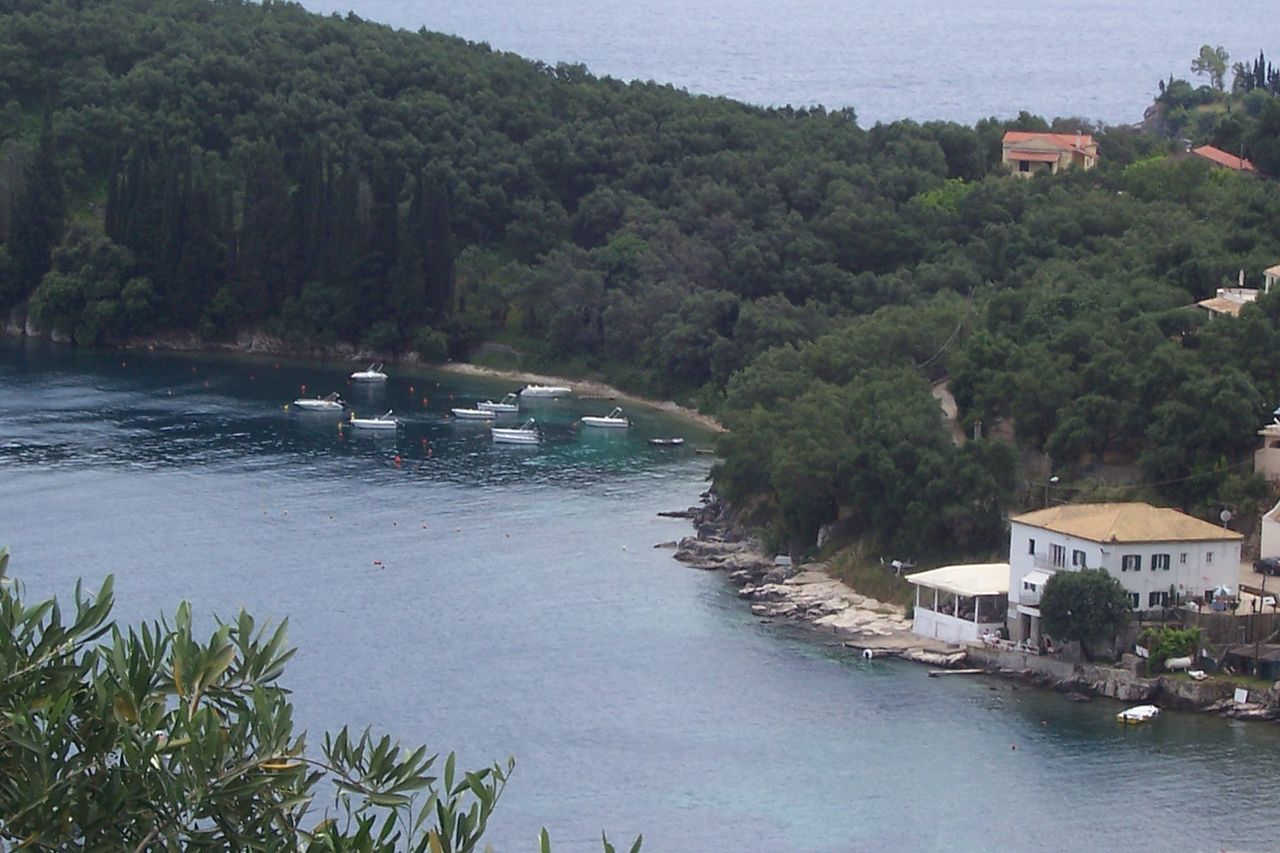
Corfu is the one sizeable piece of Greece the Ottomans never held. Venice ruled it from 1386 to 1797, and five Ottoman attempts failed (1430, 1537, 1571, 1573, 1716; only 1537 and 1716 were full sieges). That explains the tall narrow housing blocks and alleys of the Old Town, the Venetian dishes on the menus, the brass bands, a Catholic minority, and an opera house that predates the Greek state.
Antiquity. Corinthian colonists arrived in the 730s BC. By 665 BC the colony was fighting its mother city at sea, the earliest naval battle Thucydides knew of. In 433 BC the same quarrel pulled in Athens at Sybota, in the channel you look across from Kassiopi, and became one of the two triggers of the Peloponnesian War. Six years later the island's oligarchs and democrats slaughtered each other, and Thucydides turned it into his essay on civil war (3.82), whose first listed symptom is that words lose their ordinary meaning.
The name. Ostrogoths destroyed the ancient city in 551 AD. Survivors moved onto the twin peaks now under the Old Fortress; Greek Koryphó, "peaks", became Corfu in Venetian. Greeks still say Kerkyra.
Venice. In 1716 some 33,000 Ottoman troops sat outside the walls for six weeks. Schulenburg, a Brandenburg-born professional in Venetian pay, held with about 5,000 soldiers and 3,000 armed Corfiots; a storm wrecked the Ottoman camp; Venice put up his statue while he was alive, and it stands outside the fortress gate on the Spianada. Vivaldi's oratorio Juditha triumphans, premiered in Venice that November, is an allegory of the siege: Bethulia is Corfu. The olive groves are Venetian policy as well: a decree of 1623 forced planting, a bounty from mid-century paid per tree, and the 1766 census counted 1,873,730.
1797 to 1864. French rule, then the Septinsular Republic of 1800, the first self-governed Greek state since Byzantium, guaranteed by the Tsar and the Sultan together. Ioannis Kapodistrias, born in Corfu Town in 1776, went from its ministry to Russian foreign minister to first head of state of Greece. Britain ran the islands from 1815 as a "protectorate" under a Lord High Commissioner. It left the Ionian Academy of 1824, Greece's first university, thirteen years before Athens, plus the cricket, the ginger beer and the buildings on the Spianada. Britain handed the islands to Greece in 1864.
Sisi and the Kaiser. Elisabeth built the Achilleion in the years after Mayerling around a dying Achilles; Wilhelm II added an Achilles triumphant inscribed "to the greatest Greek from the greatest German", and from 1911 funded and attended, on his Easter visits, the excavation of the Gorgon temple begun by the ephor Versakis and continued with Dörpfeld.
Twentieth century. The Serbian army, about 150,000 men, was evacuated here in 1916; the sick died on Vido and some 5,000 were buried at sea, the "Blue Tomb" of Serbian poetry. Yugoslavia was agreed on Corfu in July 1917. Mussolini bombarded the Old Fortress in August 1923, killing Armenian refugees sheltering inside, his first act against a sovereign state. German bombing on 14 September 1943 destroyed the theatre, the library and the Academy. On 9 June 1944 about 1,800 Corfiot Jews were rounded up in the Old Fortress; they reached Auschwitz on 29 June. About 200 survived the war, some of them hidden by neighbours. In 1946 two British destroyers hit Albanian mines in the north channel, which became case no. 1 at the International Court of Justice. On 24 June 1994, at the EU summit on the island, Austria, Finland, Sweden and Norway signed their joint accession treaty.
Where to stand in it: Old Fortress, Spianada, Vido, Kanoni, Old Perithia, and the Capodistrias Museum at Evropouli, the family estate with its Venetian-era olive ledgers.